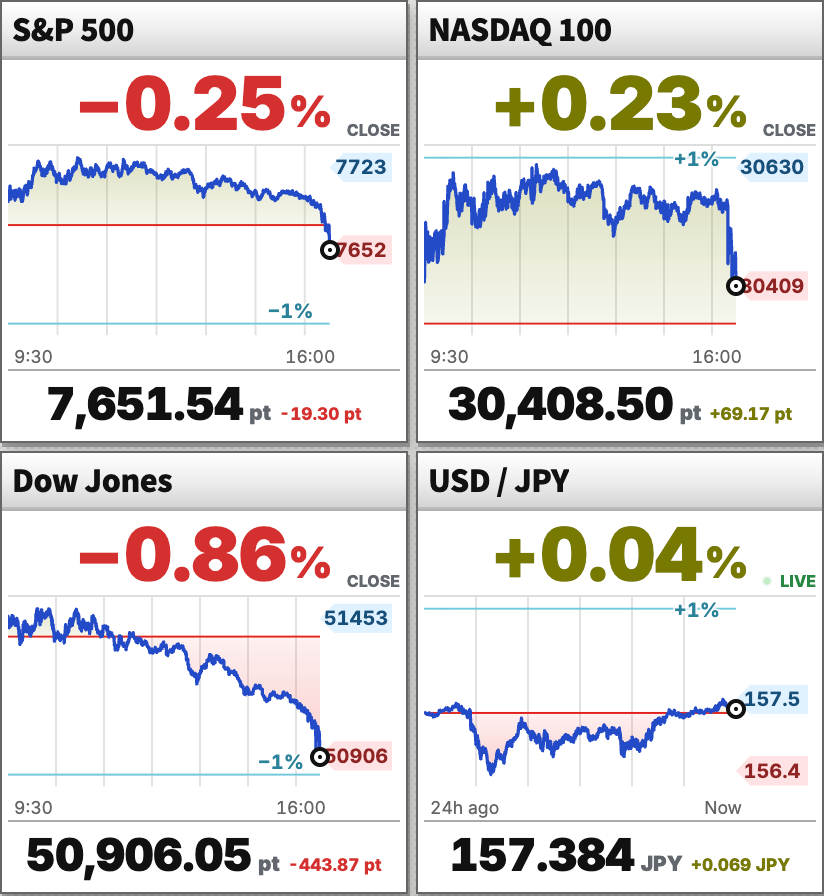
U.S. stocks lost their early momentum on September 30, with selling accelerating toward the close. The Associated Press reported confirmed closing levels of 7,651.54 for the S&P 500 and 50,906.05 for the Dow. Nasdaq put the Nasdaq 100 at 30,408.50, up 0.23%. The technology-heavy index held onto a gain, but its resilience was not enough to lift the broader market.
Charles Schwab reported that August PCE prices rose 0.3% month over month, while the core measure excluding food and energy increased 0.2%. Both readings were below market expectations. The softer inflation figures eased concerns about further rate increases, supporting stocks and lowering Treasury yields early in the session. Slower inflation provided a favorable backdrop for technology shares, whose valuations depend heavily on expectations for future profits.
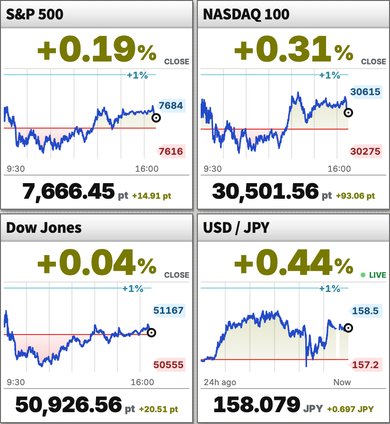
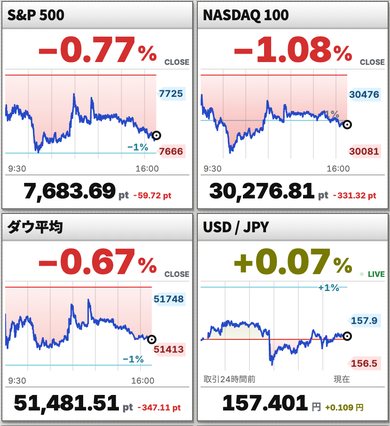
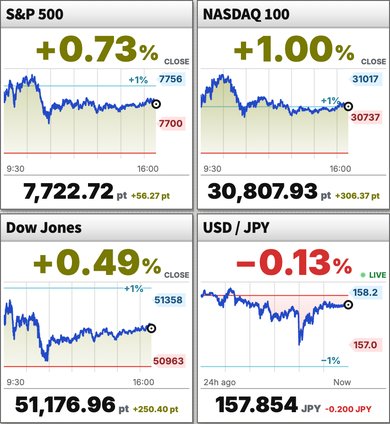
The Associated Press also reported that stronger-than-previously-estimated spring economic activity helped keep Treasury yields high and weighed on stocks. A resilient economy supports earnings, but also pushes back hopes that interest rates will fall soon. The latter effect appears to have prevailed, eroding the buying sparked by inflation relief. The charts show sharp drops in the S&P 500 and Nasdaq 100 just before the close, while the Dow extended its losses. High yields limited the market's ability to sustain a rally despite encouraging inflation news.
Opening optimism gives way to selling near the close
The S&P 500 approaches its morning high at approximately 10:30–11 a.m. Eastern time before momentum weakens. Prices drift lower from the 2 p.m. hour, then fall more sharply between about 3:30 p.m. and the 4 p.m. close. The Nasdaq 100 remains positive during the session but also surrenders a substantial part of its advance late. The Dow begins showing more pronounced weakness during the early 1 p.m. hour and fails to recover strongly. More important than the mixed closes is the failure of morning optimism to last.
The early buying fits the softer-than-expected PCE inflation figures released at 8:30 a.m. The release timing and initial response are also discussed in Interactive Brokers' commentary that day. Less intense inflation concern created some room for growth-stock valuations. Economic resilience, however, also kept the possibility of tighter policy in view, so one encouraging inflation reading did not remove the rate concern.
Different demand at a month- and quarter-end close
The acceleration in the final half-hour is consistent with month- and quarter-end position adjustment amplifying selling. The reporting-period boundary offers a reason for exposure adjustment to become more influential than the intraday market view. Buying on favorable data appears to have met selling intended to adjust exposure at the reporting-period boundary, with the latter becoming more influential late. Because the economic figures were released in the morning, the closing drop should not be described as the immediate reaction to their release.
The Nasdaq 100 retains a modest gain while the Dow posts a larger decline. Inflation-related support for growth valuations remains visible, but not enough to produce broad buying. The next test is whether prices recover the range lost near the close and hold it into the following close. Another opening advance followed by afternoon selling would suggest that position reduction still outweighs the response to favorable data. The intraday path will help determine whether the late weakness was a temporary reporting-period adjustment.
Major Index Closes
- S&P 5007,651.54 −0.3%
- Nasdaq 10030,408.50 +0.23%
- Dow Jones Industrial Average50,906.05 −0.9%