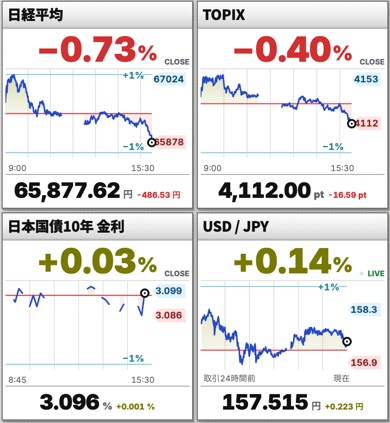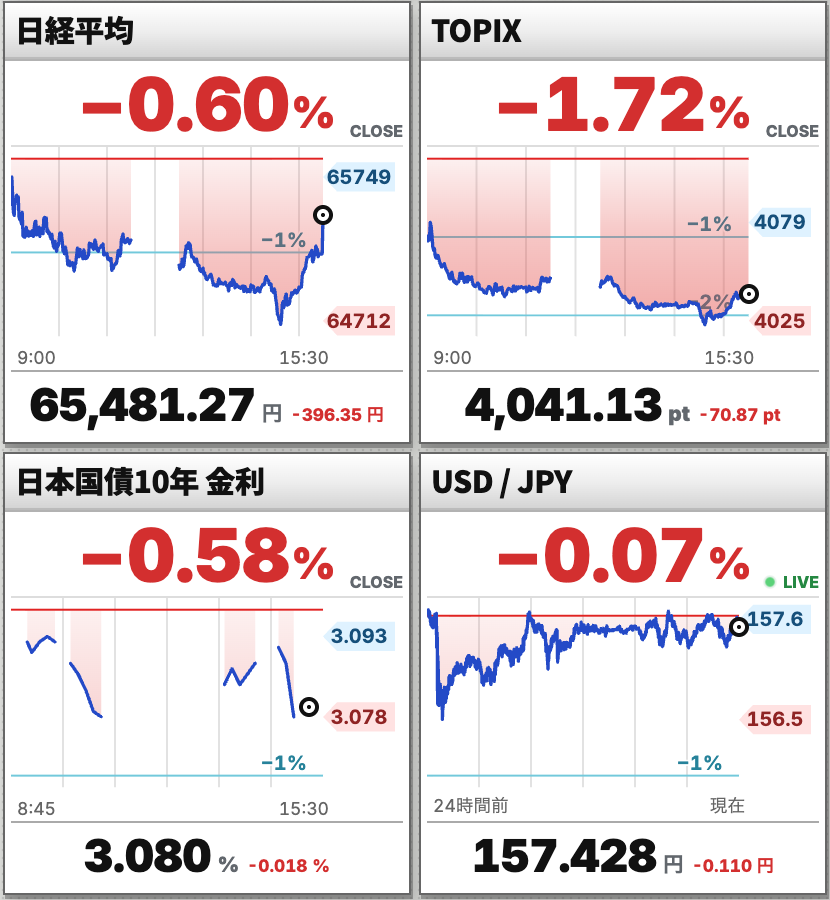
Selling dominated Tokyo trading on September 29. The Nikkei 225 fell 396.35 yen to 65,481.27, while TOPIX lost 70.87 points to 4,041.13, leaving both indexes lower for a second session. The Nikkei weakened from the open, extended losses intraday and recovered some ground toward the close. TOPIX fell more sharply, pointing to weakness beyond large-cap stocks.
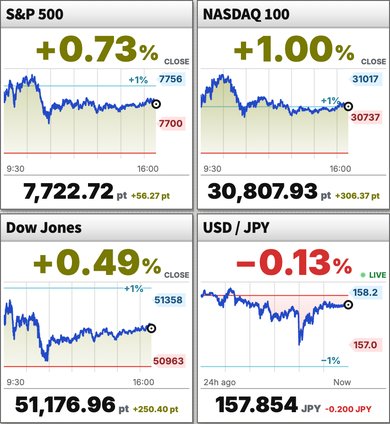
The previous session's decline on Wall Street weighed on sentiment. The Associated Press reported that Asian shares were broadly lower after U.S. losses, while rising oil prices also drew attention. September 29 was also an ex-dividend date for many Japanese companies with March year-ends; Kabutan had estimated roughly 380 yen of mechanical downward pressure on the Nikkei. Selling after the U.S. decline may therefore have coincided with dividend-related price adjustments.
Because the ex-dividend adjustment is included, the indexes' percentage declines alone do not show the full degree of investor selling. Still, both indexes fell, and TOPIX's larger drop suggests caution beyond the technical dividend adjustment. Stocks rebounded somewhat late in the day, but investors will watch whether U.S. shares, oil and interest rates remain a headwind.
The Nikkei recovers from its afternoon low near the close
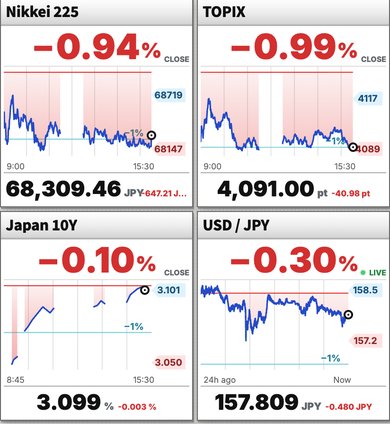
Both indexes begin below their previous closes at 9 a.m. and fail to regain those baselines during the morning recovery. After a small lift just after the 12:30 p.m. reopening, losses deepen through the 1 p.m. and 2 p.m. hours. The Nikkei approaches its low around 2:30–3 p.m., then makes a noticeable recovery in the final half-hour. The TOPIX also rebounds late, but less strongly, leaving a substantial gap between their closing losses. Both finish lower, yet renewed buying is visible in the Nikkei near the close.
It is essential to separate the ex-dividend effect from selling during the session. Removing entitlement to a dividend changes the comparison with the previous day's share price. That helps explain a negative opening, but cannot by itself explain the afternoon decline followed by the late rebound. My reading is that concern about overseas weakness and renewed demand at lower prices also shaped the intraday path.
The closing percentage does not isolate selling pressure
Even if the Nikkei's closing decline is close to the estimated dividend adjustment, it does not follow that no selling took place. Prices declined after the ex-dividend opening and subsequently recovered part of that loss. Conversely, treating the entire negative close as investor pessimism would also misread the session. The closing comparison combines a dividend-related adjustment with actual trading demand; following the chart's path helps distinguish them.
The Nikkei's late recovery alongside the TOPIX's larger remaining loss suggests that buying did not spread sufficiently across the market. A rebound in high-priced constituents can lift the Nikkei while weakness among a larger group of shares remains visible in the TOPIX. Rather than call the late rally a confirmed bottom, the next useful test is whether the TOPIX also turns higher. The rolling currency chart recovers from an earlier decline, but it cannot explain Japan's dividend-specific adjustment. The session is better evaluated through those market mechanics and the distribution of buying.
Major Index Closes
- Nikkei 22565,481.27 yen −0.60%
- TOPIX4,041.13 −1.72%