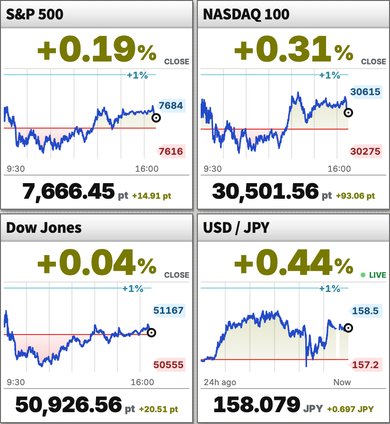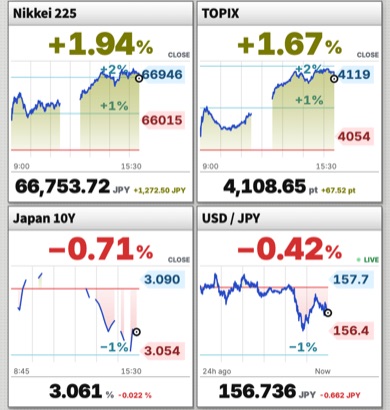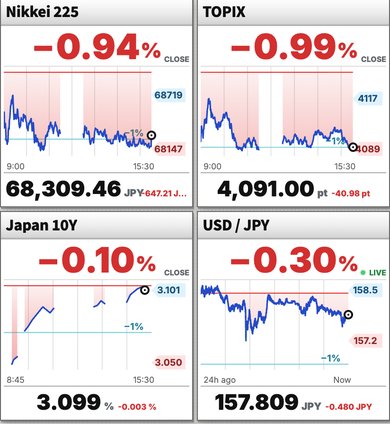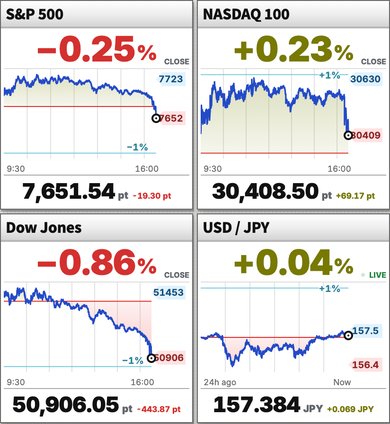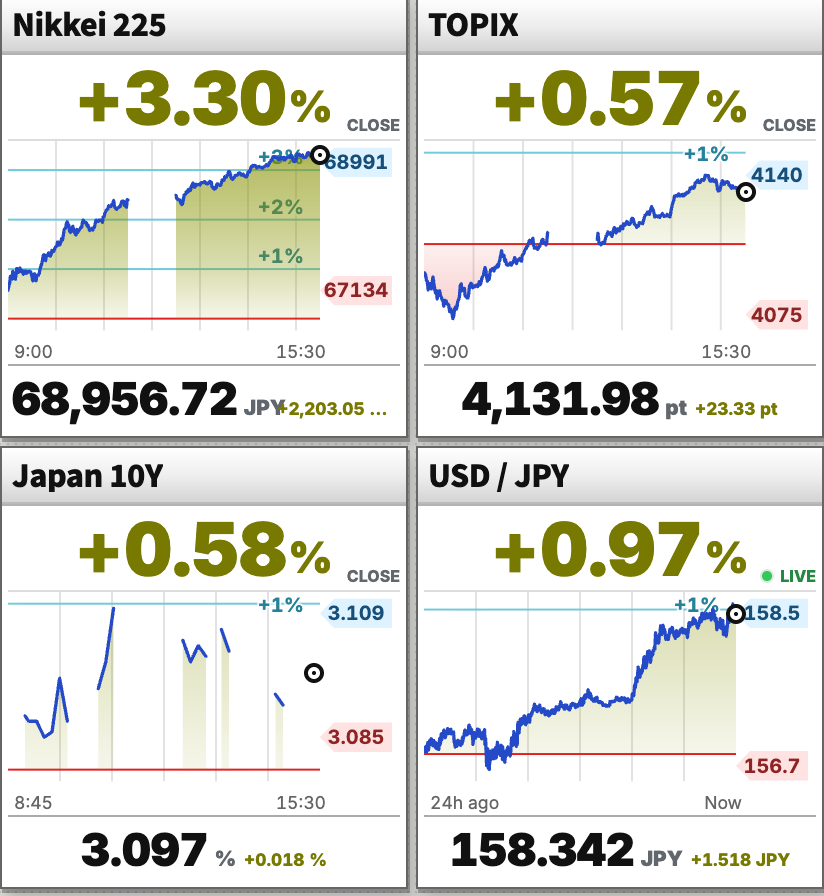
The Nikkei 225 rallied on October 1, closing at 68,956.72, up 2,203.00 points or 3.30%. TOPIX gained 23.33 points to 4,131.98, a rise of 0.57%. IwaiCosmo Securities reported that the Nikkei reached its highest closing level since August 17.
AI and semiconductor shares drove the advance. Kyodo News, via OANDA reported that Micron's results, released on the morning of October 1 in Japan, confirmed expanding AI demand. Evidence that demand is translating into sales strengthened expectations for earnings growth across related companies. The Nikkei chart rose through the morning and made further highs in the afternoon, suggesting that buying prompted by the results persisted throughout the session.
A weaker yen also helped. In its 10 a.m. report, Zai FX / DZH Financial Research said the U.S. 10-year Treasury yield had risen into the 5.30% range in off-hours trading. The Bank of Japan's Summary of Opinions favored further tightening but offered no indication of another hike in October. Tankan sentiment readings for large manufacturers and non-manufacturers both came in slightly below expectations. The morning yen decline is best read as fading expectations that the interest-rate gap between Japan and the United States would narrow quickly.
The rally was selective. IwaiCosmo Securities counted 750 rising shares and 747 falling shares on the Prime Market, an almost even split. The gap between the two indexes highlights buying concentrated in high-priced semiconductor stocks. This was a session focused on AI growth expectations rather than a broad advance across the market.
The Nikkei advances in both trading sessions
The Nikkei rises steadily from about 9:30 to 11 a.m., then moves higher again from the 12:30 p.m. reopening to roughly 2:30 p.m. Buying therefore extends beyond a single opening jump. The TOPIX, by contrast, trades below its previous close early, returns toward its baseline later in the morning and only establishes positive territory in the afternoon. The direction is shared, but the starting points and strength differ substantially.
Micron's results and outlook provide a positive signal for AI-related demand, benefiting semiconductor and associated large companies. Because high-priced shares exert greater influence on the Nikkei, that theme has a stronger impact there. The gap between the indexes' closing gains is 2.73 percentage points: Japanese equities did not uniformly gain more than 3%. The same growth theme appeared with very different intensity because of index composition.
Morning yen weakness reinforces the growth-stock theme
The 10 a.m. currency report identifies higher U.S. yields and the absence of a signal for consecutive Bank of Japan increases in October as support for USD/JPY. Yen weakness during the morning equity advance fits a currency tailwind reinforcing the semiconductor-demand theme. This does not mean the BOJ abandoned tightening; rather, immediate concern about another increase at the very next meeting did not intensify, limiting near-term demand for yen.
Currency support alone would not explain such a large Nikkei–TOPIX gap. Together with the nearly balanced numbers of advancing and declining shares, that gap indicates concentrated demand for AI and semiconductor exposure. A rising index line does not imply uniform strength underneath it. The next session's tests are both whether the leaders retain their gains and whether buying spreads to the TOPIX. Broader participation would strengthen the rally's foundation; without it, dependence on a smaller group of large shares would persist.
Major Index Closes
- Nikkei 22568,956.72 JPY +3.30%
- TOPIX4,131.98 +0.57%