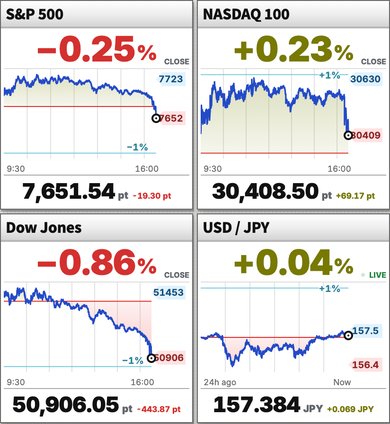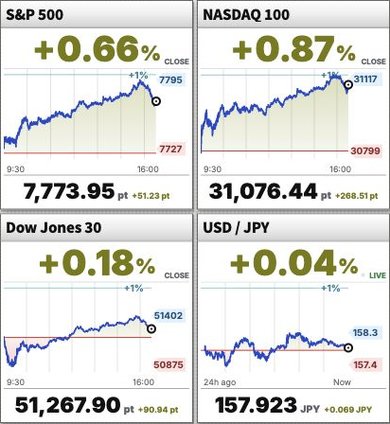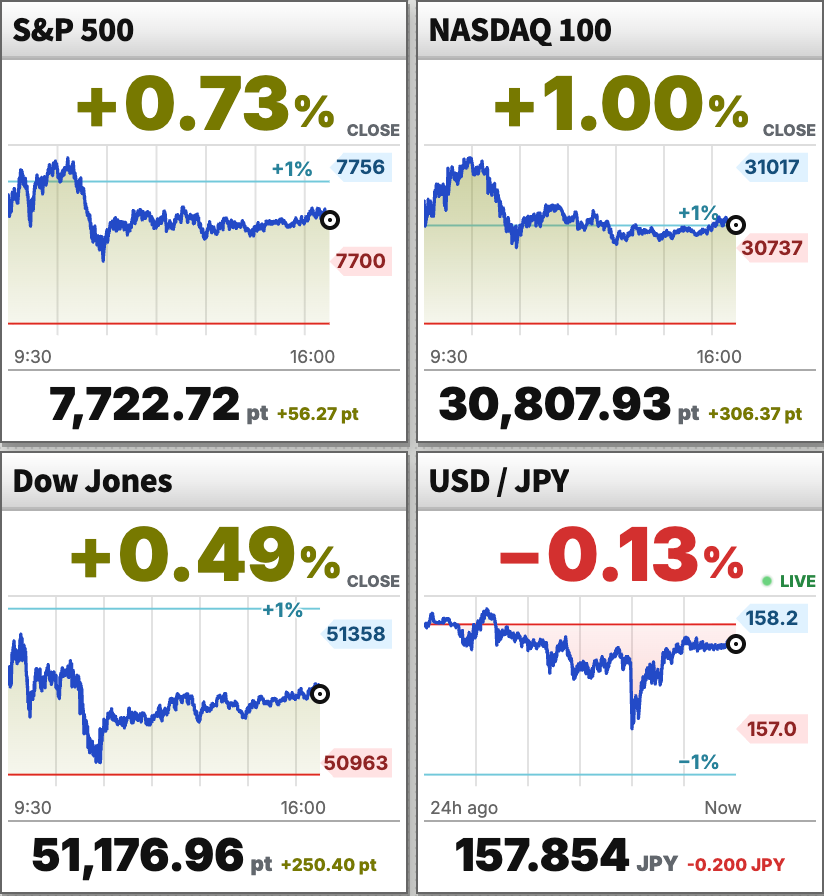
U.S. stocks extended their gains on October 2. The Associated Press closing table put the S&P 500 at 7,722.72 and the Dow at 51,176.96, while Nasdaq reported a Nasdaq 100 close of 30,807.93. The charts show an early advance followed by a sharp pullback, with trading settling into a steadier range in the afternoon. The growth-heavy Nasdaq 100 outperformed the Dow, reflecting their different sensitivity to interest rates.
The September employment report, released by the Bureau of Labor Statistics at 8:30 a.m. Eastern, showed payroll growth of 29,000 and unemployment of 4.2%. Average hourly earnings rose just 0.1% on the month, and payroll estimates for July and August were revised down by a combined 60,000. With both hiring and wages showing less heat, investors appear to have seen less urgency for another rate increase.
USD/JPY fell sharply around the release before recovering. Slower hiring appears to have prompted dollar selling as investors reduced expectations for further increases in U.S. yields. For equities, the same shift offered support by lowering the discount rate applied to future earnings. The response was driven more by relief over monetary tightening than by confidence in economic strength.
The Associated Press reported that the U.S. 10-year Treasury yield briefly fell below 5.17%, then recovered to 5.28% as oil pared its losses. Renewed concern about inflation from energy prices best explains why stocks surrendered part of their early advance. Slower hiring supported equities, while the recovery in oil and long-term yields limited the upside.
Separate the 8:30 a.m. release from the later pullback
The employment report arrives at 8:30 a.m. Eastern time, an hour before regular stock trading opens. The charts show the S&P 500 and Nasdaq 100 advancing into elevated ranges through approximately 10:30 a.m., followed by a pronounced retreat at about 10:45–11:30 a.m. The Nasdaq 100 gives back a substantial part of its early gain but remains above its previous close. Trading is then more stable through the afternoon, with gains preserved late. The initial response to the report and the subsequent adjustment are distinct phases.
Weak employment and wage growth appear to have supported stocks by easing concern about additional rate increases, not by signaling a stronger economy. The downward dollar move and growth-stock advance fit the same interpretation of rates. The Nasdaq 100's stronger close relative to the Dow also supports that reading. Rising stocks after weak employment data make sense when the immediate valuation response to rates matters more than the direct assessment of economic strength.
Holding gains after the retreat matters
My reading of the morning pullback is that profit-taking after the early advance met renewed concern as oil and yields recovered. The reported rebound in yields also supports a contest between buying on weaker employment and selling on renewed inflation concern. Early optimism was partly restrained by inflation risk. Yet the indexes' ability to remain above their previous closes in the afternoon suggests that the favorable implication of the jobs report was not entirely rejected.
The Dow's smaller gain also points away from a broad economic-acceleration trade. Strong hiring as the principal catalyst would offer more direct support to cyclical exposure. Here, growth companies with greater sensitivity to reduced tightening concerns led instead. The next test is whether the afternoon range holds if oil or Treasury yields rise again. The gains remaining after the pullback are a better indication of how deeply the news changed valuations than the size of the first rally alone.
Major Index Closes
- S&P 5007,722.72 +0.73%
- NASDAQ 10030,807.93 +1.00%
- Dow Jones Industrial Average51,176.96 +0.49%