Japanese investors often encounter the idea of starting with “Orukan,” an all-country stock fund. In the U.S. ETF market, S&P 500 funds, total-U.S.-market VTI and developed-ex-U.S. VEA are major building blocks. Why do regional funds attract so much capital when a single global fund is available?
The central choice is one global fund versus separate U.S. and non-U.S. allocations. Regional ETFs serve both investors concentrating on the U.S. and investors diversifying globally. Large VTI and VEA assets do not imply that international diversification is unpopular.
Orukan is a Japanese product, not a U.S. ETF category
Orukan is the nickname of Japan’s eMAXIS Slim All Country mutual fund. Its manager identifies its benchmark as the MSCI All Country World Index, including dividends and translated into yen. Comparing that Japanese product name directly with U.S. ETF tickers is not a popularity ranking.
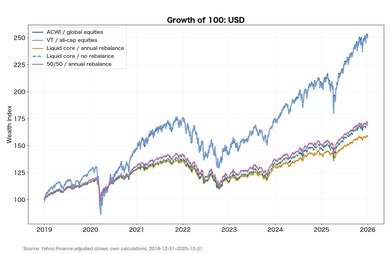
U.S. investors also have one-fund global options. ACWI follows MSCI ACWI, while VT follows the FTSE Global All Cap Index. VT includes small caps; ACWI focuses on large and mid caps. Global investing exists in the U.S.; regional building blocks coexist with it.
ETF assets show the scale of the building-block approach
Vanguard’s June 30, 2026 factsheets allow a same-date comparison of ETF net assets—not combined ETF and mutual-fund assets. VTI held approximately $663.5 billion, VEA $230.9 billion and global-stock VT $77.6 billion.
| ETF | Coverage | ETF assets / annual expense ratio |
|---|---|---|
| VTI | Total U.S. stock market | $663.488 billion / 0.03% |
| VEA | Developed markets excluding the U.S. | $230.949 billion / 0.03% |
| VT | Global developed and emerging markets, including the U.S. | $77.627 billion / 0.06% |
Sources: Vanguard’s VTI, VEA and VT factsheets. Assets measure fund scale, not holders’ nationality or headcount. They reflect both accumulated flows and investment performance.
For a U.S. investor, the S&P 500 and VTI are domestic stocks
U.S. equities are foreign investments from Japan, but domestic holdings for Americans. Familiar businesses, readily followed earnings and everyday news make them an intuitive foundation. The tendency to overweight one’s home market is known as home bias.
The S&P 500 represents large U.S. companies. VTI extends the domestic building block to mid- and small-cap shares. Overseas revenue earned by U.S. businesses does not make holding them identical to owning foreign companies. Establishing a domestic core and adding international diversification remain distinct decisions.
VEA complements VTI rather than competing with it
VEA separates developed markets such as Japan, Europe and Canada from U.S. equities. Regional funds allow direct control over a target allocation—for example, a hypothetical 70% U.S. and 30% non-U.S. mix—rather than accepting a global fund’s market weights.
VTI plus VEA alone omits emerging markets. Adding a fund such as VWO fills that role. VXUS combines developed and emerging non-U.S. markets, allowing a broad two-part VTI-plus-VXUS portfolio. Index providers classify countries and select securities differently, so these combinations do not exactly reproduce MSCI ACWI.
One fund offers automatic market weights; separate funds offer control
A capitalization-weighted global fund adjusts its regional mix as company values change. Investors accept the market’s recipe without choosing individual country targets. That simplicity is its strength.
Regional ETFs accommodate existing holdings and chosen targets. Someone already holding substantial U.S. equities in another account can direct new money abroad. Contributions can also help rebalance after U.S. outperformance. The trade-off is responsibility: choosing and maintaining the mix requires more decisions.
Costs help explain the appeal, but are not the whole story
The cited factsheets show 0.03% annual expenses for VTI and VEA versus 0.06% for VT. Long-term holders pay attention to recurring costs. But VTI plus VEA does not cover the same universe as VT, so this is not an identical portfolio at a different price.
Coverage, spreads, commissions and rebalancing transactions also matter. A single fund’s convenience has value. Japan’s Orukan and U.S. ETFs operate in different product and investor environments; the scale of U.S. regional ETFs does not prescribe the same structure for a Japanese investor.
Past U.S. strength reinforces preferences without eliminating global investing
Vanguard’s global-diversification analysis discusses U.S. outperformance alongside the value of combining domestic and international stocks. Strong past results attract attention and help explain why investors favor a U.S. core. This is an explanation of the appeal, not a forecast that leadership must persist.
VEA’s size is itself evidence of demand for non-U.S. exposure. Looking only at all-world ETF assets misses diversification assembled across separate funds. The more useful question is the combined U.S. and non-U.S. allocation, rather than whether an investor owns a single global ticker.
Compare U.S. leadership and global participation on this board
Place the S&P 500, VTI, VEA and ACWI in one tab on Jibun Stocks. The S&P 500 and VTI often look similar because large U.S. companies carry substantial weight in both. When VTI leads, check whether buying is extending into smaller companies. When the S&P 500 leads, large-cap concentration is a useful starting point.
VTI rising while VEA lags reveals different regional assessments. Both rising indicates participation across regions. ACWI includes the U.S., so its line can resemble U.S. large-cap moves. Use VEA or VXUS to isolate the non-U.S. component rather than expecting a global chart to look completely different.
VEA trades in dollars during U.S. hours, but its holdings’ local exchanges are not necessarily open simultaneously. Local closing prices, currencies and subsequent news shape its U.S. trading price. A Japanese yen-denominated mutual fund has a different valuation schedule and currency. Compare matching-time ETF percentage changes rather than assuming same-date values must coincide.
Regional ETFs offer a domestic foundation plus the freedom to assemble international exposure. An all-world fund offers the convenience of one market-weighted package. Understanding that distinction clarifies both fund popularity and which markets belong together on your dashboard.
Official sources
- MUFG Asset Management — All Country fund benchmark
- Vanguard — VTI factsheet, June 30, 2026
- Vanguard — VEA factsheet, June 30, 2026
- Vanguard — VT factsheet, June 30, 2026
- iShares — MSCI ACWI ETF
- Vanguard — Think differently about global diversification