Index investing is no longer a niche. ICI reports that U.S. domestic equity index mutual funds and ETFs received a cumulative $2.9 trillion during 2016–2025, including reinvested dividends. Active domestic equity mutual funds lost $3.4 trillion. The active category below excludes active ETFs: these figures describe different product populations, not a complete active-versus-passive market-share calculation. They nevertheless show a pronounced shift in demand. ICI, 2026 Fact Book, Figure 3.9
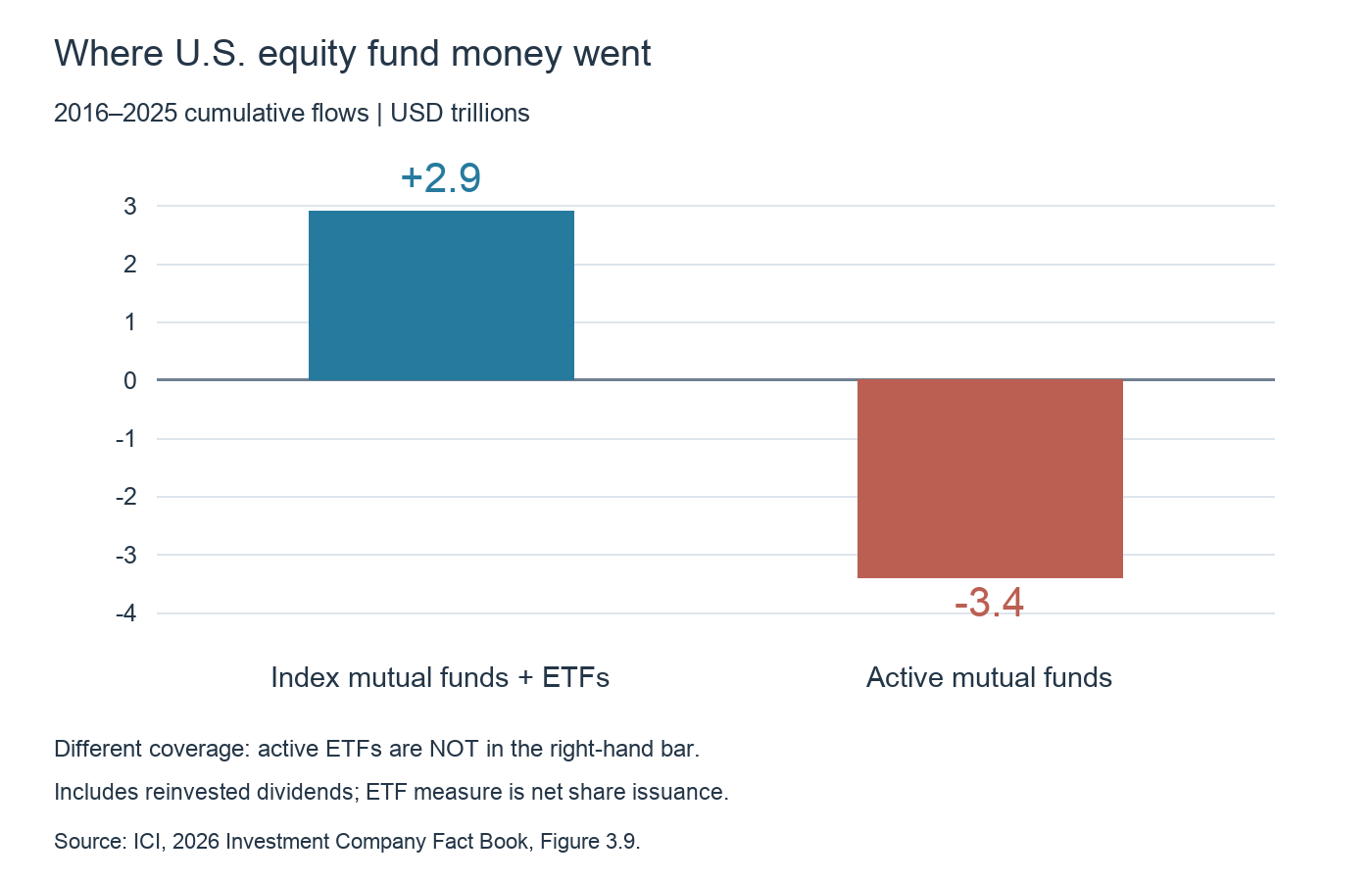
Low costs, broad ownership and less need to select individual winners explain the appeal. The harder questions concern who discovers prices, who writes index rules, and who bears the consequences. These are more useful criticisms than the old complaint that matching an average is unambitious.
The 1970s: indexing met resistance from the start
One institutional starting point was the indexed portfolio developed at Wells Fargo in 1971. Participant David Booth recalls an initially equal-weighted NYSE strategy. The now-familiar association between indexing and capitalization weighting was not its only original form. Booth’s firsthand account
John Bogle brought the approach to ordinary investors through First Index Investment Trust, established at the end of 1975 and launched in 1976. His retrospective records just $11.32 million raised against a $150 million target. Competitors called it “Bogle’s Folly”; promotional material even called index funds “un-American.” Why settle for average when a professional could aim higher? Bogle’s 2005 speech
William Sharpe’s 1991 arithmetic provided a powerful answer. Across owners of the same market, aggregate returns before costs are the market return; the higher-cost side loses ground in aggregate after costs. This explains the value of inexpensive implementation. It does not prove that every market price is correct or that an index is always cheap. The Arithmetic of Active Management
1. If everyone stops investigating prices, who sets them?
An index tracker does not normally compare every company’s prospective cash flows with its share price before deciding whether to buy. It follows a benchmark. That shortcut benefits from the analysis and arbitrage performed by other market participants.
Grossman and Stiglitz formalized a tension in 1980: if costly information were already perfectly reflected in prices, collecting it would have no reward. The incentive to produce the information would disappear. Market efficiency and compensation for information cannot be separated. This is a theoretical objection to perfect informational efficiency, not a forecast that index funds must fail. The original paper
A majority passive ownership share is not a demonstrated cliff edge. Ownership is different from the trading that sets the next price. Direct stockholders, hedge funds and corporate repurchases also exist outside the mutual-fund comparison. Greater mispricing can make research and arbitrage more rewarding. The relevant question is whether these mechanisms remain effective, not whether one headline percentage has crossed 50%.
2. The benchmark does not just describe a market; it influences portfolios
Eligibility, financial-sector exclusions and float treatment are design decisions. Index inclusion changes what tracking funds hold. A published methodology is a rulebook, not a law of nature.
In 2019, then-SEC Commissioner Robert Jackson and Steven Davidoff Solomon highlighted index-provider discretion, conflicts and transparency. Their concern was not simply fund fees: it was the authority to redirect investment through benchmark decisions. Their SEC-hosted discussion
SpaceX and the Nasdaq-100: compliance does not end the governance debate
Effective May 1, 2026, Nasdaq introduced fast entry for qualifying large new listings, including candidates ranking within the top 40 by full market capitalization. The mechanism permits entry after 15 trading days. On June 26, Nasdaq announced that SpaceX would join before the market opened on July 7. Effective methodology / Official inclusion announcement
Calling that an admission in defiance of published rules would misstate the sequence. The more substantial criticism concerns the rule change itself. Shortening the seasoning period brings new-listing volatility into existing investors’ portfolios sooner. A passive decision to follow an index accepts active decisions by its designer.
Nasdaq explains the change as a response to companies growing very large before going public. It removed the 10% minimum-float eligibility requirement but also introduced a cap on weighting capitalization at three times eligible float capitalization for low-float securities. Admission became easier while a weighting safeguard was added. Ignoring that safeguard would weaken rather than strengthen the criticism. Nasdaq’s rationale and FAQ
My concern is not a prediction about SpaceX’s business. A corporate group operating both a listing venue and an index business must explain how it separates the attractiveness of its exchange from the burdens placed on existing index investors. Public consultation matters; it does not eliminate that tension. This is a governance criticism, not an allegation of an established rule violation.
3. Diversification does not screen out overvaluation
A capitalization-weighted portfolio gives larger market values larger weights. It does not repeatedly ask whether each valuation is justified. A long list of holdings can still become dependent on a small number of expensive leaders.
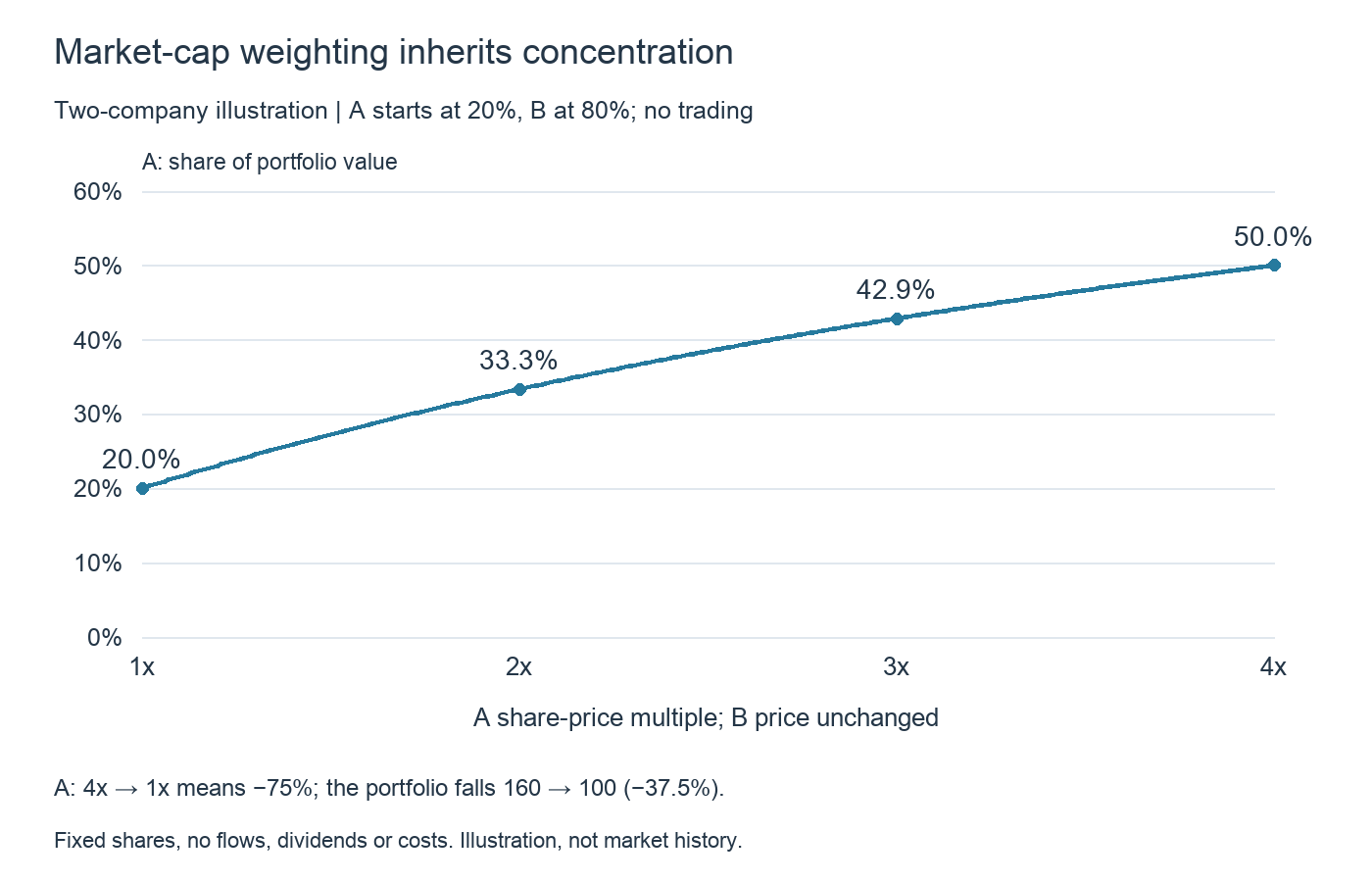
In this deliberately simple example, company A starts at 20 and B at 80. If A quadruples and B stays unchanged, total value rises to 160 and A’s weight becomes 50%. No additional A shares need to be purchased. Holding the original shares already follows the changing capitalization weights. New subscriptions and constituent changes create other trades; they should not be confused with this automatic weight drift.
If A returns to its original price, A loses 75% and the portfolio falls from 160 to 100, or 37.5%. Diversification reduces the loss relative to owning A alone but does not eliminate the exposure accumulated during its rise. This is a fixed-share illustration, with no flows, dividends or costs, not a historical backtest or a prediction of a bubble.
Robert Shiller’s Irrational Exuberance examined valuations and investor psychology around the 2000 boom. Its relevance here is not that Shiller should be recast as an opponent of indexing. It is that buying a market does not settle the question of whether its prices are sensible. Yale’s contemporary account
4. Reconstitution costs and concentrated voting power
Published constituent changes make some future trades predictable. Anticipatory trading, crowded execution and price impact can impose costs beyond a fund’s expense ratio. That does not make inclusion announcements a guaranteed trading profit: expectations can be priced earlier and effects can change over time. Turnover and realized tracking quality deserve attention alongside headline fees.
Delegating holdings also commonly delegates voting. Many dispersed beneficial owners can therefore rely on a concentrated group of managers to exercise corporate votes. A Federal Reserve staff paper revised in 2020 identifies increasing asset-management concentration as one risk. It also finds that the passive shift reduces certain liquidity and redemption risks, while evidence about return and liquidity comovement is mixed. Those findings do not support treating every passive strategy as an identical source of instability. The researchers’ assessment
| Issue | What can go wrong | What to distinguish |
|---|---|---|
| Price discovery | Less fundamental research may weaken price signals | Fund ownership share is not trading share; there is no established universal tipping point. |
| Index governance | Eligibility and weighting changes redirect investment | Published rules can still change; read consultation results and effective dates. |
| Concentration and valuation | A broad index can inherit expensive, dominant stocks | A different weighting scheme changes exposures; it does not guarantee better returns. |
| Reconstitution | Predictable trades can create implementation costs | Costs and inclusion effects vary by market and period. |
| Voting power | Many investors delegate votes to a few managers | More accounts or fund brands do not necessarily mean different voting agents. |
Use this site to connect construction with observable price differences
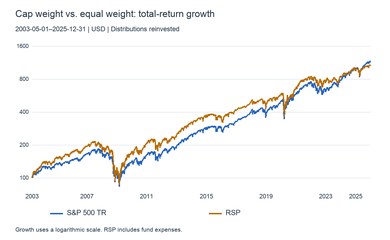
Place the S&P 500 beside RSP to compare capitalization and equal weighting within large U.S. companies. A stronger S&P 500 alongside a weaker RSP is a starting point for investigating leadership concentrated in larger companies. Remember that RSP is an ETF and the S&P 500 is an index; intraday percentage moves are not long-term total returns.
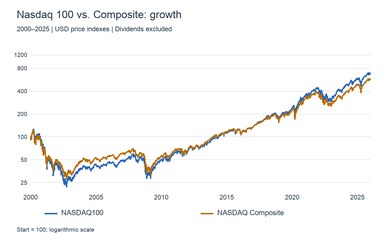
The Nasdaq-100 focuses on large non-financial Nasdaq companies, while VTI covers the U.S. equity market more broadly. Four panels do not mean four independent assets: substantial large-company overlap remains. Compare matching trading periods, then examine holdings, weighting and methodology changes. A price difference alone neither measures fund flows nor proves a bubble.
Knowing the weaknesses changes how to use the strategy
These criticisms do not automatically make an expensive active fund a better choice. Research costs, transaction costs and judgment errors exist there too.
Broad, inexpensive ownership can remain the core approach. Do not expect the benchmark to protect you from concentration or high valuations. Read eligibility rules and changes, not just index names. Keep spending reserves outside equities and choose an allocation that can survive a substantial drawdown. Indexing removes many recurring decisions; it does not make the remaining decisions on your behalf.
Data and references
- ICI — 2026 Investment Company Fact Book, Figure 3.9
- David Booth — 1971: The Beginning of a New Way to Invest
- John C. Bogle — The Chief Cornerstone (2005)
- William F. Sharpe — The Arithmetic of Active Management (1991)
- Grossman & Stiglitz — On the Impossibility of Informationally Efficient Markets (1980)
- Jackson & Solomon — What’s Really in Your Index Fund? (2019)
- Nasdaq-100 — Methodology effective May 1, 2026
- Nasdaq — May 2026 methodology changes FAQ
- Nasdaq — SpaceX inclusion announcement, June 26, 2026
- Yale — Shiller’s Irrational Exuberance, January 2000
- Anadu et al. — The Shift from Active to Passive Investing (2020 revision)